



كيف أعادت ESMA تشكيل رافعة عقود الفروقات للأفراد، ولماذا لم تغادر الحدود قط
ما الذي تنص عليه فعلًا حدود الرافعة المالية التي فرضتها ESMA عام 2018، وإحصاءات الخسائر التي استندت إليها، وكيف تحوّل إجراء طارئ مدته ثلاثة أشهر إلى قاعدة دائمة في أوروبا.
نُشر في 12 أغسطس 2026قراءة 9 دقائقمتاحة بالإنجليزية
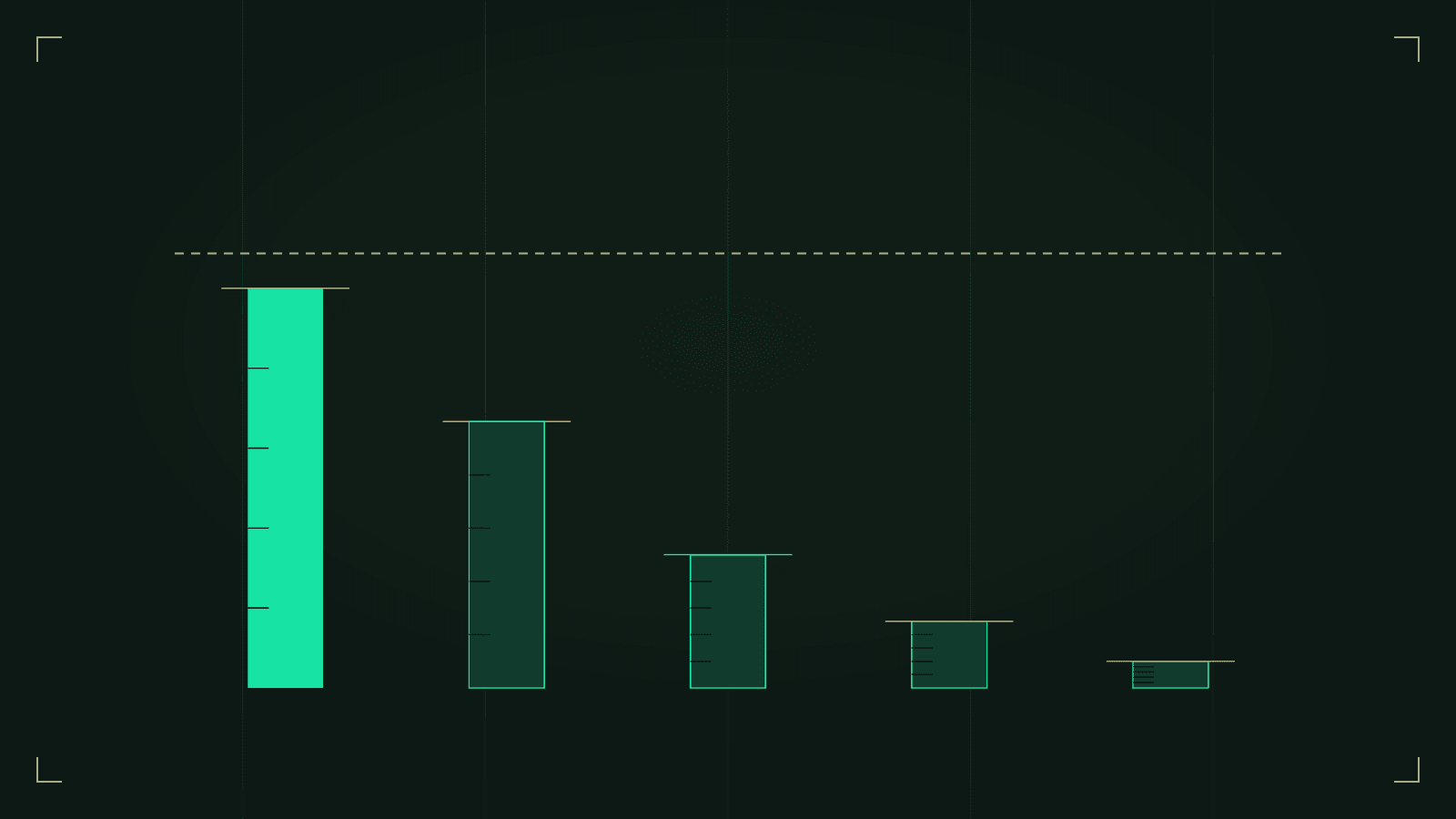
On 1 August 2018, the highest leverage a regulated broker could offer a retail CFD account in the European Union stopped being a commercial decision and became a legal schedule. The European Securities and Markets Authority had reached for a power it had never used before, product intervention under Article 40 of MiFIR, and the decision it published that June, Decision (EU) 2018/796, still shapes every leverage table you will read today 1.
This article walks through what the intervention actually says, the loss statistics that drove it, what the caps mean in cash terms for a retail account, and how a package designed to expire every three months became the permanent architecture of European CFD regulation.
Five measures, one decision
ESMA announced the final measures on 1 June 2018, and the CFD restrictions applied from 1 August 2. The package has five parts, and they were designed to work together rather than alone 1:
- Leverage caps by underlying: initial margin a retail client must post, set as a percentage of the position's notional value.
- A margin close-out rule: when account funds plus unrealised profit and loss fall below 50% of the initial margin required for all open positions, the provider must start closing them. The test runs per account, not per trade.
- Negative balance protection, also per account: total liability is capped at the money in the account, which can reach zero but not go below.
- A standardized risk warning that must state the percentage of the provider's own retail accounts that lose money, recalculated every three months over the trailing twelve months.
- A ban on incentives: no payment, monetary or non-monetary benefit in relation to the marketing, distribution or sale of a CFD. The only carve-outs are realised profits on the CFD itself and, for non-monetary benefits, information and research tools. Deposit bonuses and rebate schemes fall on the wrong side of that line.
| Underlying | Initial margin | Maximum leverage |
|---|---|---|
| FX pairs of any two of USD, EUR, JPY, GBP, CAD, CHF | 3.33% | 30:1 |
| Other FX pairs, gold, major equity indices | 5% | 20:1 |
| Commodities other than gold, other equity indices | 10% | 10:1 |
| Individual shares, anything not otherwise listed | 20% | 5:1 |
| Cryptocurrencies | 50% | 2:1 |
Notice two details. 'Major FX' means any pair built from six named currencies, which is why CAD/CHF sits at 30:1 while EUR/NOK sits at 20:1. And the 20% tier is the catch-all: shares and anything the annex does not name default to 5:1, with only cryptocurrency treated more severely.
The evidence regulators published
Product intervention is an emergency power, and ESMA had to document the emergency. The decision's recitals compile studies from national regulators, and they read consistently in one direction: most retail CFD accounts lost money, across every country that counted 1. Ireland's central bank found 74% of retail clients losing money over 2015–16, with an average loss of €2,700. Italy's CONSOB found losses in 2016 running at up to 83% of clients, averaging roughly €7,000. France's AMF found more than 89% of retail investors losing over 2009–13, averaging €10,887.
- Losing retail clients — Ireland, 2015–16
- 74%†
- Losing retail clients — Italy, 2016
- up to 83%†
- Losing retail investors — France, 2009–13
- 89%+†
The same recitals record what leverage looked like before the caps: levels across the Union ranged from 3:1 to 500:1, with the UK regulator observing 200:1 as typical for major currency pairs and 500:1 (occasionally higher) from providers targeting smaller retail clients 1. The link between the two findings is mechanical rather than moral: higher leverage raises the share of outcomes in which a small adverse move ends the account. Why most traders lose money unpacks that arithmetic.
CFDs are complex instruments and come with a high risk of losing money rapidly due to leverage. [insert percentage per provider] % of retail investor accounts lose money when trading CFDs with this provider. You should consider whether you understand how CFDs work and whether you can afford to take the high risk of losing your money.
Standardised warning template, Decision (EU) 2018/796, Annex II, Section B
What 30:1 means in cash
Put numbers on it. One standard lot of EUR/USD is €100,000 of notional exposure. At 500:1, the initial margin for that position was €200; at 200:1, €500. Under the cap it is 3.33% of notional, about €3,330. The position itself is identical in every case: the same exposure, the same value per pip. What changed is the cash that must stand behind it.
That matters because margin is the buffer between an adverse move and an empty account. At 500:1, a move of 0.2% against the position (roughly twenty pips on EUR/USD) consumes the entire margin. At 30:1, the required margin absorbs a 3.33% move, more than three hundred pips. Fund an account with exactly the €3,330 minimum and hold that single position, and the 50% close-out rule triggers once equity falls below €1,665 (around a 1.67% adverse move), at which point the provider must begin closing positions 1. Negative balance protection then bounds the worst case at whatever the account holds.
None of this makes a leveraged position safe, and the caps were never claimed to. A 30:1 trade still moves your equity thirty times faster than an unleveraged one, and the close-out rule is a brake, not a stop-loss: in a fast market, positions close at the price available, not the price that triggered the rule. What the schedule does is slow the speed of ruin and put a floor under it. How the product works under the hood is covered in how CFDs work.
From temporary fix to permanent architecture
Article 40 measures lapse after three months unless renewed, so ESMA renewed: Decisions (EU) 2018/1636, 2019/155 and 2019/679 carried the restrictions through a full year 3. Then, on 31 July 2019, ESMA announced it would stop renewing — not because the policy had failed, but because most national regulators had by then adopted permanent national measures at least as stringent. The EU-wide decision expired that day with the national rules in its place 3.
The UK's permanent version made two deliberate edits. The FCA's policy statement PS19/18, published in July 2019, wrote the ESMA package into its Handbook with effect from 1 August 2019 for CFDs and 1 September 2019 for 'CFD-like options', a category ESMA never covered, added so firms could not rebuild the old product under a new name 4. In the other direction, it relaxed one tier, setting 30:1 rather than ESMA's 5:1 for CFDs on certain government bonds. It estimated the package would save retail consumers between £267m and £451m a year 4. In Cyprus, home to a large share of Europe's retail CFD industry, CySEC followed on 27 September 2019 with policy statement PS-04-2019. It had consulted on a risk-based alternative that would have let some retail clients trade at up to 50:1; the final statement abandoned that idea and adopted ESMA's leverage limits unchanged, for all retail clients 5.
The result is quietly remarkable: a measure with a three-month legal lifespan has outlived its own legal basis, outlived the UK's EU membership, and now defines the retail CFD product on both sides of that divide. The caps are not an EU quirk a broker can wait out. They are the product.
How to read a broker's leverage table today
Eight years on, a leverage table is a regulatory document wearing a marketing layout. Four questions extract what it actually says:
- Which entity would hold your account? The caps travel with the regulator, not the brand. An EU or UK entity carries the full package; an offshore entity of the same brand may offer 500:1 again, without the close-out rule, the negative balance guarantee or the loss disclosure.
- Are you being nudged toward 'professional' status? Elective professionals lose the retail protections wholesale. The FCA flagged inappropriate opt-ups as a supervisory priority the moment its rules took force 4.
- Do the tiers match the schedule? 30:1 on six-currency majors, 20:1 on gold and major indices, 10:1 on other commodities, 5:1 on shares, 2:1 on crypto. A regulated table is not the broker's opinion of you; deviations tell you which rulebook (if any) you are under.
- What is the number in the risk warning? That is the provider's own trailing twelve-month loss percentage, recalculated quarterly under the standard ESMA introduced. It is the one line of a CFD website that is prescribed arithmetic rather than copy.
The 2018 intervention did not change what a CFD is; it standardised the terms on which retail clients meet one. The leverage schedule sets a ceiling, the close-out rule sets a brake, and the warning label publishes the base rate. What none of them can do is size a position. That arithmetic stays with the trader, which is why position sizing beats prediction is the discipline the caps quietly assume you will bring.
Free, ungated calculators for margin, position size and pip value, built on the same tiered margin percentages described above.
Run the margin maths yourselfالمصادر
الوثائق الأولية التي دُقّقت المقالة عليها.
- European Securities and Markets Authority (EUR-Lex, OJ L 136) Decision (EU) 2018/796 — temporary restriction on contracts for differences in the Union (Article 40 MiFIR) · حتى 1 يونيو 2018
- European Securities and Markets Authority ESMA adopts final product intervention measures on CFDs and binary options · حتى 1 يونيو 2018
- European Securities and Markets Authority ESMA ceases renewal of product intervention measures relating to contracts for differences · حتى 31 يوليو 2019
- Financial Conduct Authority PS19/18: Restricting contract for difference products sold to retail clients · حتى 1 يوليو 2019
- Cyprus Securities and Exchange Commission Policy Statement PS-04-2019 on the imposition of national measures in relation to the marketing, distribution and sale of CFDs · حتى 27 سبتمبر 2019